
Determination of the Cleanliness Class in a Hot Air Sterilization Tunnel
1 Introduction
1.1 Objective
As part of the qualification (OQ), the integrity of HEPA filters of filter class H 13 and the cleanliness class in a hot air sterilization tunnel should be measured in the cold state (23C).
This is a hot air sterilization tunnel used for the sterilization and depyrogenation of vials.
This report will now discuss whether it is necessary and sensible to demonstrate the cleanliness class also in operation, i.e., in the hot state (240C). The cleanliness in the tunnel essentially depends on the retention capacity of the filters and the quality of sampling in the hot state:
- 1. How does a HEPA filter behave at higher temperatures?
- 2. What influence does the higher temperature have on sampling?
1.2 Definitions
1.2.1 Definition: at rest (cold)
Cleanliness classes are defined in Annex 1, EU GMP Guide, for two operational states: at rest and in operation.
Cleanliness classes are defined in Annex 1, EU GMP Guide, for two operational states: at rest and in operation.
For demonstrating the cleanliness class in a hot air sterilization tunnel, the ‘at rest’ operational state, from our understanding, means testing in the cold state, i.e., no vials are on the conveyor belt, the fans for the tunnel’s air supply are running, but the heating for the heating section is switched off.
1.2.2 Definition: in operation (hot)
For demonstrating the cleanliness class in a hot air sterilization tunnel, the ‘in operation’ operational state, from our understanding, means testing in the hot state, i.e., no vials are on the conveyor belt, the fans for the tunnel’s air supply are running, and the heating for the heating section is switched on.
1.3 Objective
The objective of this report is to demonstrate that the cleanliness class in the hot air sterilization tunnel should be measured in the ‘at rest’ (cold) operational state. There are two reasons for this:
- 1. The separation efficiency of HEPA filters increases at higher temperatures, thereby improving the cleanliness class.
- 2. At higher temperatures, the separation of aerosol particles in the particle counter’s intake system also increases due to enhanced thermophoresis. As a result, demonstrating the cleanliness class in the ‘in operation’ (hot) state is subject to greater measurement uncertainties than in the cold state.
2 Filter Characteristics
2.1 Penetration Curve and MPPS
Filter characteristics refer to the functional curve of penetration as a function of particle size. Small aerosol particles are separated due to Brownian motion (Einstein diffusion), while large particles are separated due to the so-called interception effect and their inertia. Aerosol particles that are already too large to be effectively separated by diffusion but not large enough to be effectively separated by inertia effects show the highest penetration, known as MPPS: Most Penetrating Particle Size.
2.2 MPPS Test
The penetration curve resembles an inverted parabola and has a distinct maximum at the MPPS. It is precisely at this point that the filter is tested and classified according to DIN EN 1822. The position of the MPPS depends on other parameter values of the filter medium, e.g.:
- mean fiber volume density or packing density
- sheet thickness of the filter medium (caliper)
- fiber diameter or fiber size distribution
- approach velocity to the flat filter medium
- air temperature (dispersion medium)
- ambient pressure
2.3 Calculation of Penetration
For more than 70 years, filter theory has been continuously developed. Filter theory refers to the mathematical-physical theory of aerosol filtration in fibrous filter media. With the help of suitable structural and flow models, the separation efficiency or penetration of aerosol particles in fibrous filter media can be calculated, and the influence of the aforementioned parameters can be investigated. The filter model we use was developed in the 1970s by Fuchs, Stechkina, and Kirsch [1] and is subsequently referred to as the FSK model.
2.4 HEPA Filter H 13
2.4.1 Technical Data
In the heating section of a hot air sterilization tunnel, for example, an H 13 filter from Camfil was assumed, model or filter designation: 1FRKV-725-1W. Such temperature-resistant HEPA filters are usually only available in H 13 quality. The filter medium usually consists of quartz glass fibers without binders, which would evaporate anyway at high temperatures. Corrugated metal separators are used to stiffen the construction and separate the pleats, as they are resistant to high temperatures.
The following technical data were taken from the Camfil brochure (Absolute 1FRK) and the filter test report:
- Dimensions W H D: 610 457 292, each in mm and as external dimensions of the filter frame
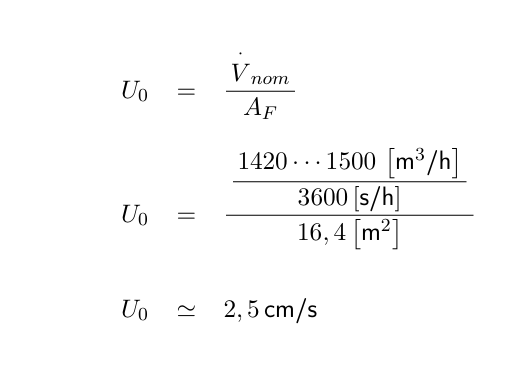
- Filter area AF : 16.4 m2
- Nominal volume flow Vnom: 1500 or 1420 m3/h
- Pressure differential: 250 Pa
- Velocity to the flat filter medium:
2.4.2 Result
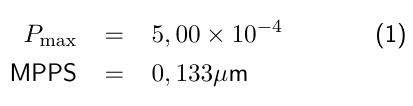
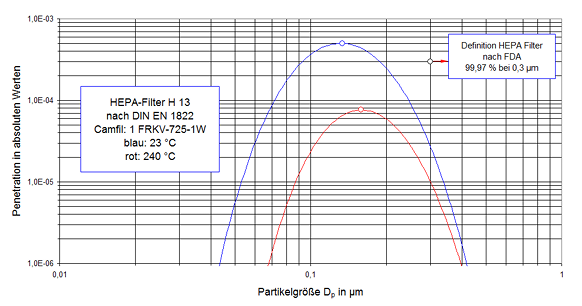
At a normal ambient temperature of 23C, the filter characteristic for the H 13 filter is expressed by a separation efficiency of 99.95% at MPPS or a maximum penetration (Pmax) of 0.05% or absolutely 5×10⁻⁴ at MPPS:
At a temperature of 240C, the separation efficiency increases, or penetration decreases, due to improved diffusion separation, and from this, the following filter characteristic is obtained according to the FSK model:
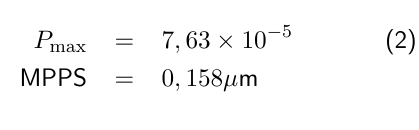
As can be seen, the penetration at 240°C decreases by a factor of 6 compared to the penetration at 23°C. The information about the MPPS at 0.3 µm in the Camfil filter test reports cannot be correct. The calculated MPPS is between 0.133 and 0.158 µm.
3 Demonstration of Cleanliness Class
3.1 Measurement in the Room
The demonstration of the cleanliness class is carried out according to the method described in ISO 14644-1. An Optical Particle Counter (OPC) is used to measure the particle concentration in cleanrooms. This measurement is performed at typical ambient temperatures. All locations where cleanliness classes need to be demonstrated are also easily accessible, so no intake systems in the form of sampling hoses are required.
3.2 Measurement in the Cold Tunnel
The special considerations for demonstrating the cleanliness class in a hot air sterilization tunnel are that an intake system is now required. To reach the more distant locations in the tunnel, a sampling hose longer than 3 m is needed. Typically, a so-called beverage hose (Bev-A Line) is used to connect the isokinetic sampling probe to the particle counter. This hose is very smooth internally and electrostatically dissipative to prevent, or at least minimize, the deposition of aerosol particles due to electrical charge. Nevertheless, particle deposition cannot be entirely avoided. Turbulent pipe flow prevails in the hose, and turbulence causes turbulent transverse movement and inertial deposition of particles on the inner surface of the pipe.
For particles of 0.5 µm, this deposition is negligible, but for those of 5 µm, it is considerable the longer the hose. This creates measurement uncertainty, as only particles that reach the view volume of the particle counter can be counted.
3.3 Measurement in the Hot Tunnel
If the requirement is to measure the cleanliness class during heating operation, i.e., in operation, the intake system must be modified. Due to the high temperatures, a stainless steel sampling tube with jacket cooling must be used. The cooling of the sample air serves to protect the particle counter. At a temperature of 240C, all optical and electronic components in the OPC would be destroyed.
The cooling creates a temperature gradient, meaning the temperature of the sample air in the immediate vicinity of the inner wall surface of the sampling tube is significantly higher than that of the wall surface itself. This temperature gradient causes thermodiffusion, also known as thermophoresis, and drives the particles to the cold tube surface. Particle deposition is enhanced.
4 Summary
- 1. There is no dedicated regulatory requirement that recommends or prescribes demonstrating the cleanliness class in the hot state for hot air sterilizers (or similar).
- 2. Demonstrating the cleanliness class in the hot air tunnel ‘in operation’ offers no advantage because the separation efficiency of HEPA filters increases at higher temperatures, and the cleanliness class improves, or the particle concentration in the tunnel decreases as a result.
- Due to the cooling of the sampling system, which is necessary to protect the particle counter when demonstrating ‘in operation’ (hot), significant particle loss due to thermodiffusion is to be expected. Particles that do not reach the OPC cannot be counted and represent a large measurement uncertainty, or even call into question the demonstration of the cleanliness class altogether.
- Demonstrating the cleanliness class ‘at rest’ (cold) represents the stricter test and is therefore recommended.
Appendix
Filter Characteristics using the example of a Hot Air Sterilization Tunnel
References
1
[1] Kirsch, A. A. and Stechkina, I. B.: The Theory of Aerosol Filtration with Fibrous Filters, Chapter 4, pp.:165-256, in Fundamentals of Aerosol Science, ed. D. T. Shaw, John Wiley & Sons, New York, 1978