
Conversion of Humidity Parameters for Nitrogen and Compressed Air
Water Content and Relative Humidity
Dalton’s Law
Dalton’s Law applies to gas mixtures. It is assumed that the individual gases in the mixture can be treated according to the ideal gas law. Humid air or humid nitrogen are typical examples of such ideal gas mixtures. They are composed of pure dry air or pure dry nitrogen and water vapor, which, as a gaseous state of water, also behaves according to the ideal gas law. According to Dalton, each individual gas in the gas mixture fills the entire available volume V and exerts a so-called partial pressure. The sum of the partial pressures yields the total pressure p, which can be measured with a manometer at a small bore in the vessel wall:
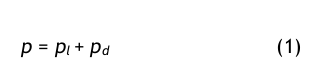
where pₗ = partial pressure of air and pd = partial pressure of water vapor.
Water Content
The water content x is defined as follows:
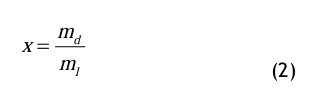
with md = mass of vapor and ml = mass of dry air. The water content, as a concentration quantity, refers to the mass of pure dry air, very similar to the definition of molality. The ideal gas law is now applied to both components:
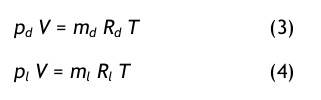
with the specific gas constants for vapor, Rd, and for air, Rl, respectively. From these two equations, one obtains:
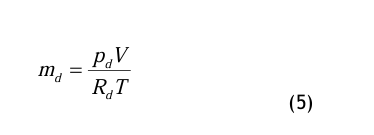
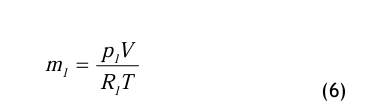
Equations (5) and (6) are inserted into the definition equation (2) for water content and transformed as follows:
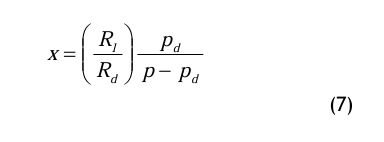
Relative Humidity
At this point, the relative humidity φ is introduced and defined as follows:
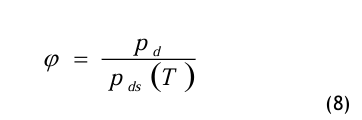
Relative humidity is a ratio, where the partial vapor pressure pd is related to the saturation vapor pressure pds (T). The vapor pressure at saturation pds depends only on temperature T. Equation (8) is inserted into Equation (7):
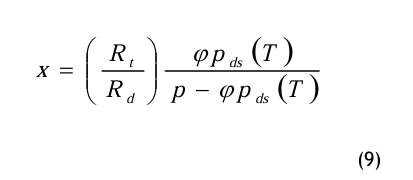
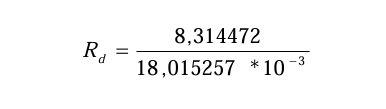
The specific gas constants are determined as follows:

where R0 = 8.314472 J/(mol K), the molar gas constant according to the latest Codata-98 version, and Md = 18.015257 g/mol, the molar mass of pure water. This yields:

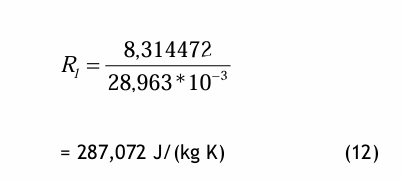
For pure dry atmospheric air, Ml = 28.963 g/mol, and thus:
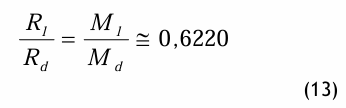
The ratio of the specific gas constants is inversely proportional to the ratio of the molar masses and is:
Saturation Vapor Pressure
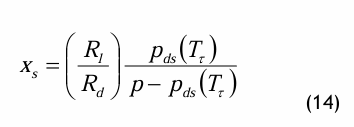
At saturation, φ = 1 and the saturation temperature reaches the dew point: T = Tτ. Beyond the dew point, excess water vapor will condense, e.g., in the form of droplets. This dew point can be measured, for example, with so-called dew point mirrors. The water content at saturation, xs, is then:
In thermodynamics, water content is usually used. The so-called Mollier diagram for humid air, also known as the h-x diagram, is also based on this.
Saturation Vapor Pressure
The saturation vapor pressure pds (T) is defined as the pressure of pure vapor that is in equilibrium with the flat surface of its own pure liquid or ice, without any admixture of foreign gases. The saturation vapor pressure of pure water, thus defined, also called saturated vapor pressure or simply vapor pressure, depends solely on temperature.
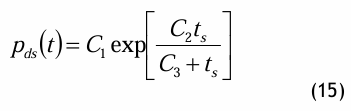
The vapor pressure curve of water, the so-called p-T curve, has been reformulated repeatedly over the past 150 years in line with growing scientific understanding. Today, the formulation from 1997 by the International Association for the Properties of Water and Steam, or IAPWS1, is considered the reference equation. Although this equation can be programmed without great difficulty, for example, in Excel, it will not be presented here due to the need for a more extensive explanation. Instead, the simple Magnus equation from DIN 50 010-2 will be used, which, while not meeting the high requirements of IAPWS, provides sufficiently accurate values and is also cited or used by ISO 8573-3.
The Magnus equation is a simply structured vapor pressure equation, characterized by the fact that it can be explicitly rearranged for temperature: the so-called inverse equation. The Magnus equation is as follows:
and the corresponding inverse equation:
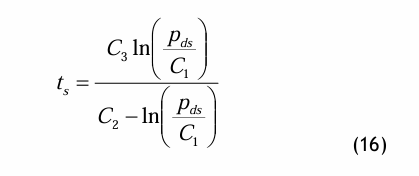
The constants are explained in the following table.
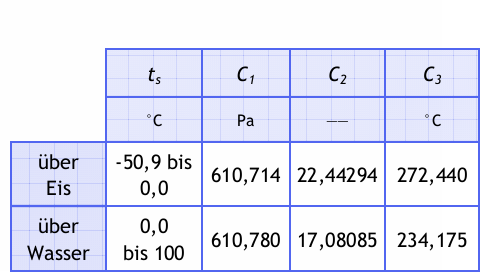
Table 1 Constants of the Magnus Equation
Mass Concentration
Volume Concentration
In Ph. Eur. 4, the limit value for water vapor content is given as volume concentration CV. The volume concentration, also called volume fraction or volume proportion, for water vapor is defined as follows:
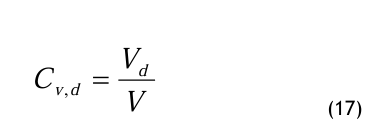
The volume fraction is therefore a dimensionless quantity that relates the partial volume Vd of water vapor to the total volume V. Usually, the volume fraction is given in percent (%) or per mille (0/00). For very small values, one uses:
- parts per million = ppmv = 1/1,000,000 = 10−6
- parts per billion = ppbv = 1/1,000,000,000 = 10−9
The volume fraction for compressed gas humidity must be converted into a simpler form for measurement. Dalton’s Law serves this purpose once again:

From this, the following equation is easily obtained:

Compressed gas humidity is always related to the dew point, and thus one obtains:

From the inverse equation of the vapor pressure formula, the pressure dew point is obtained:

Mass Concentration
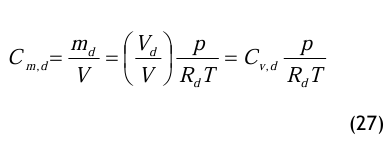
The mass concentration or mass fraction Cm,d is defined as follows:
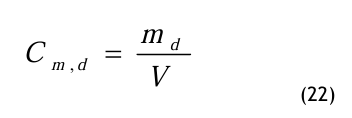
The mass fraction is a dimensioned quantity in kg/m3, also g/m3, mg/m3, or μg/m3. The mass of the vapor md is related to the total volume V of the humid compressed gas. The partial vapor pressure or the volume fraction can be used for conversion.
Based on Partial Vapor Pressure
The conversion is performed using Dalton’s Law in the form of Equation (3):
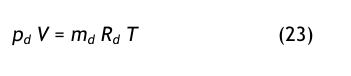
From this follows:
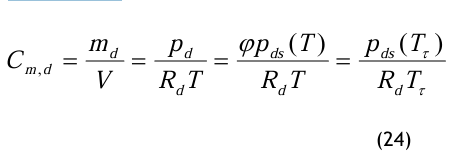
The calculation of the mass fraction is performed via the pressure dew point or the partial vapor pressure calculated from it.
Based on Pressure and Volume Fraction
The conversion here also uses Dalton’s Law in the following form:

This first yields:
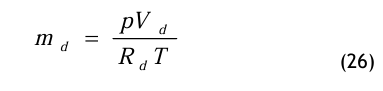
and inserted into Equation (22) thus yields:
Example Calculation
To illustrate the described conversion equations, an example will be worked through completely. According to Ph. Eur. 4 (Aermedicalis, pp. 591-594), the limit value for humidity in pharmaceutical compressed air or nitrogen is specified as follows:

Unfortunately, Ph. Eur. 4 did not state at which pressure this value is to be verified. Therefore, a pressure of 1 atm = 101325 Pa is assumed.
This determination also seems plausible, since according to 2.1.6, pp. 19 of Ph. Eur. 4, the verification should be carried out using Water Vapor Detector Tubes, and this verification usually occurs under atmospheric pressure conditions, see also Fig. (2.1.6-1) of Ph. Eur. 4. The temperature is assumed to be t = 20◦C or T = 293.15 K.
Conversion from Volume Fraction to Mass Fraction
At a pressure of p = 101 325 Pa, according to Equation (27), one obtains:
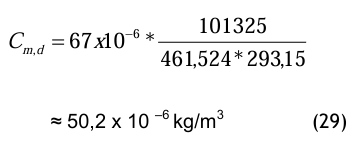
The mass fraction is therefore Cm,d = 50.2 mg/m3. This conversion is necessary to select the appropriate test tube according to its measuring range in mg/m3.
Conversion to Pressure Dew Point
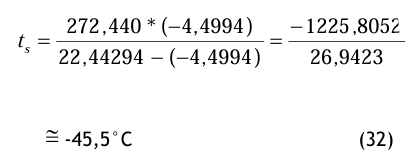
The specified volume fraction of humidity of 67 ppmv is converted into the pressure dew point. First, according to Equation (20), the partial vapor pressure at the pressure dew point must be calculated. Then, according to the inverse equation (16) of the Magnus equation, the saturation temperature can be calculated, which is equivalent to the pressure dew point temperature. This procedure naturally depends on the reference pressure.
Reference Pressure p = 1 atm
According to Equation (20),
pds = 101 325 * (67 × 10−6) ≅ 6.7888 Pa (30) This is then entered into Equation (16), where the Magnus constants for the case over ice are chosen and the following intermediate result is used:
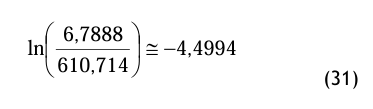
and thus obtains:
Reference Pressure p = 8 bar
The same calculation for 8 bar yields the following values:
pds = 800 000 * (67 × 10−6) ≅ 53.6 Pa (33)
with the intermediate result:
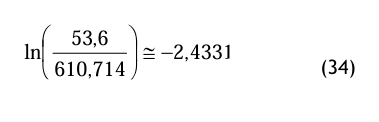
and thus:
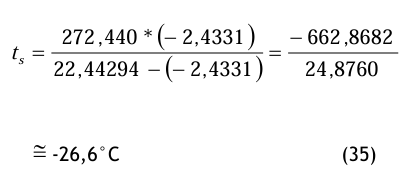
This pressure dew point would be measured with a corresponding measuring device in the compressed air line at a pressure of 8 bar (absolute).
Conversion to Saturation Water Content
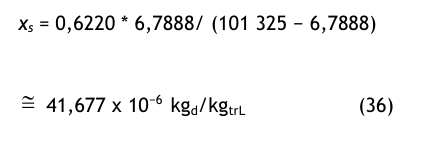
Reference Pressure p = 1 atm
The saturation water content is calculated according to Equation (14):
Reference Pressure p = 8 bar
The same calculation for 8 bar yields the following value:
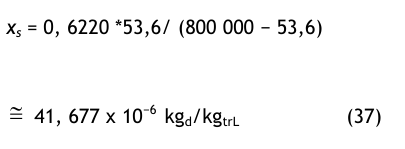
In both cases, the water content remains constant with pressure changes and is:

Measurement Uncertainty with Dräger Tubes
Ph. Eur. 4 recommends measuring compressed gas humidity of 67 ppmv using Dräger tubes. The corresponding Dräger test tube has the following characteristics:
- Test tube designation: Water vapor 5/a-P
- Standard measuring range: 5 to 200 mg/m3
- Test volume: 50 L
- Sample flow rate: 2 L/min
- Measurement duration: 25 min
- Standard deviation: ± 15…20 %
- Color change: yellow → reddish brown
In the lower measuring range (67 ppmv = 50.2 mg/m3), a measurement uncertainty of ± 20 % should rather be expected. The total uncertainty must also include the measurement uncertainty of the volume flow measurement in the budget: estimated ± 20 %, whereby the uncertainty of the time measurement was neglected.
The estimated total uncertainty is thus:
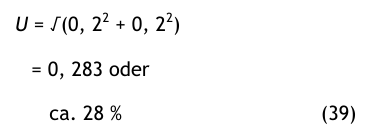
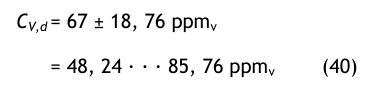
The total uncertainty in ppmv units is then:
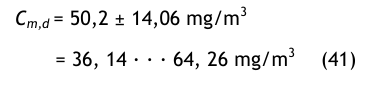
The total uncertainty in mg/m3 units at atmospheric pressure is correspondingly:
The lower and upper values of the humidity content are now converted to pressure dew point at a pressure of 1 atm using the calculation method shown above:
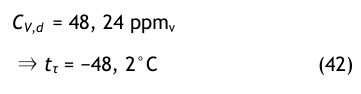
and
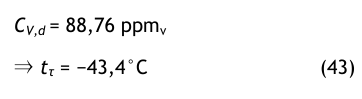
The two pressure dew points differ by Δt = 4.8 K.
Testo® Dew Point Measuring Device
Based on a Testo dew point measuring device, for a humidity limit value of 67 ppmv, the following pressure dew point would be measured at 8 bar:

For the lower and upper pressure dew points, the saturation vapor pressure is calculated according to the Magnus equation with respect to p = 8 bar:
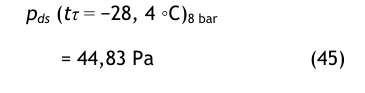
and
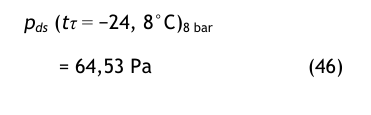
These values are converted to a pressure of p = 101 325 Pa with the following results:
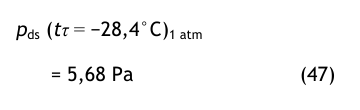
and
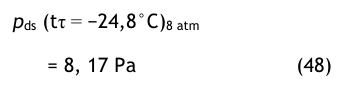
The saturation values at atmospheric pressure are then converted into volume fractions:
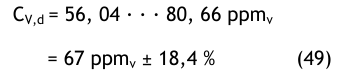
It can be seen that the volume fractions can be measured more accurately with the dew point determination method than with the test tube method.
Nevertheless, the first method still has a considerable measurement uncertainty, which is caused by the measurement of very low relative humidity of approx. 2%. The great advantage of dew point determination is that the entire measuring range from −55°C to +20°C can be continuously measured. With the test tube method, it may be necessary to use 4 different test tubes to cover this measuring range.
References
1
All IAPWS formulations on the material properties of water and steam are freely available online under the so-called IAPWS Releases: www.iapws.org