
Quality Requirements for Pure Steam in the Pharmaceutical Industry
1 Introduction
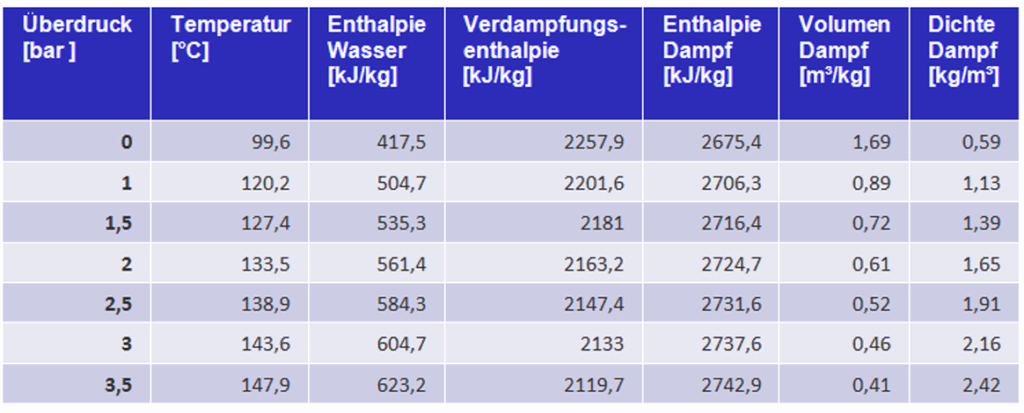
Pure steam is primarily used for sterilization in the pharmaceutical industry. This is because water is an excellent energy carrier. A large amount of energy is required for vaporization, which can be released quickly during condensation. The enthalpy values for dry, saturated steam are shown in the steam table.
The first prerequisite for feed water is that it must have drinking water quality. Further specifications for the feed water are defined by the manufacturer.
These specifications are met by purified water (PW), so in practice, the pure steam system is fed from an existing PW system. The feed water should be degassed before it enters the evaporator. This is necessary to reduce the amount of non-condensable gases (NCGs) and to avoid an interfering variable in conductivity measurement due to dissolved CO2. Especially with online conductivity measurement, where conductivity is only evaluated according to Stage 1 as per the pharmacopoeia, exceedances can occur due to dissolved CO2. As a remedy, either membrane degassing or a degassing tank is used.
For steam generation, natural circulation, falling film, or pure steam generators with external heat exchangers are then employed.
The generators are additionally equipped with droplet separators to prevent the entrainment of condensate and dissolved impurities, such as endotoxins.
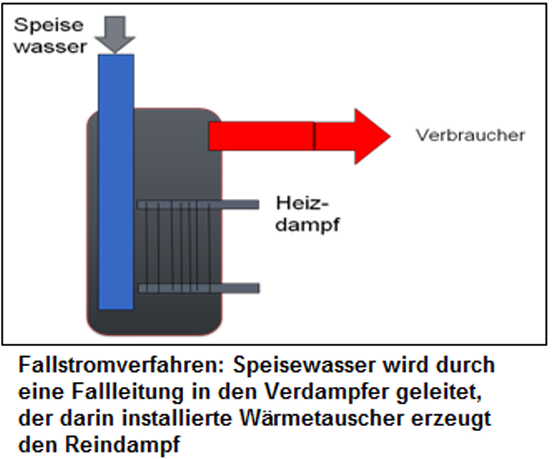
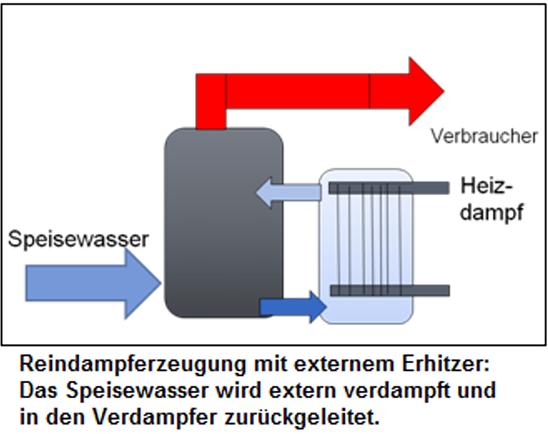
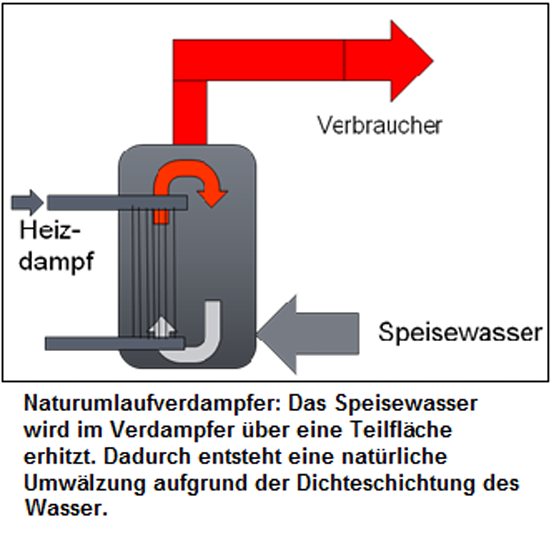
Operation of the Pure Steam Generator
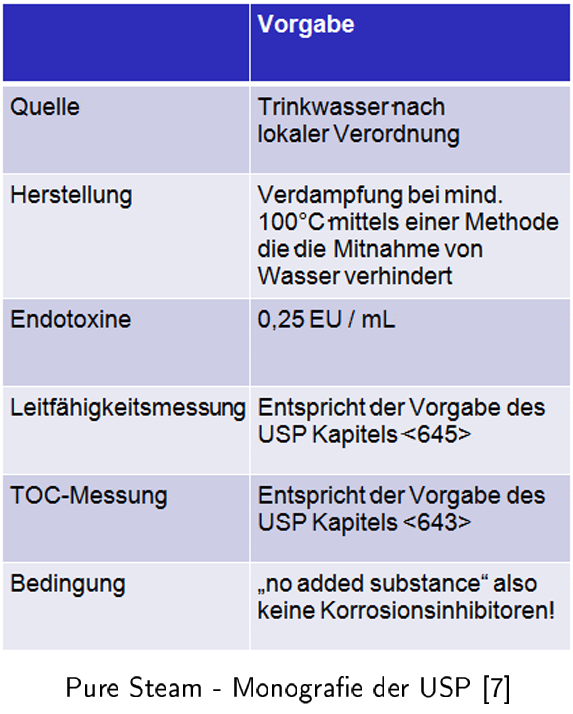
To operate the pure steam system, temperature and pressure must be measured. These parameters are required for system control. It is important that pure steam must be generated by evaporation at a minimum of 100°C and must not contain any additives. In addition to these two parameters, other quality-relevant parameters must be checked, which are specified in the relevant regulations. On the one hand, requirements for the condensate of pure steam are demanded in the USP monograph Pure Steam [7], which correspond to the requirements for Water for Injection (WfI). This means that the endotoxin content must not be greater than 0.25 EU/mL, and the conductivity and TOC content must meet the requirements of chapters <643> and <645> of the USP [7]. Furthermore, specifications for pure steam quality are laid down in DIN EN 285 [1] and DIN 59850 [2]. These two standards specify, in addition to testing the condensate, limit values for the properties of the steam. The parameters to be examined are: superheat, dryness, and non-condensable gases. The tests can be carried out either with the offline method described in DIN EN 285 [1] or with any comparable measuring system. With the available alternative systems, it is possible to determine these three parameters, which will be presented in more detail below, online.
Non-Condensable Gases
Measurements according to DIN EN 285
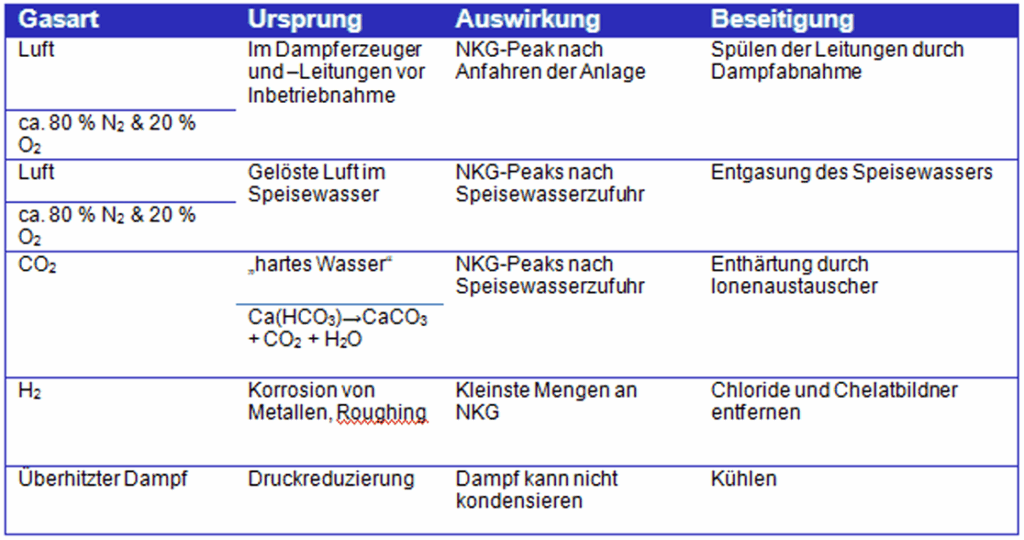
Non-condensable gases (NCGs) prevent direct contact of the steam with the sterile goods and make complete sterilization impossible. During the process, the steam should condense and destroy any biomass present with the transferred enthalpy. NCGs act as an insulator and prevent direct energy transfer by forming gas layers or pockets. NKGs are introduced by the feed water, especially if no degassing is upstream. This is particularly favored if the feed water remains in a storage and distribution system open to the atmosphere for an extended period. Due to continuous circulation and the use of spray balls, air, especially CO2, can dissolve in the feed water. The table below summarizes the potentially occurring NKGs . NKGs are measured at the highest point of the distribution system, as gas pockets are more likely to form there. The steam should have a maximum volume fraction of 3.5% NCGs in the condensate.
Dryness
Measurements according to DIN EN 285
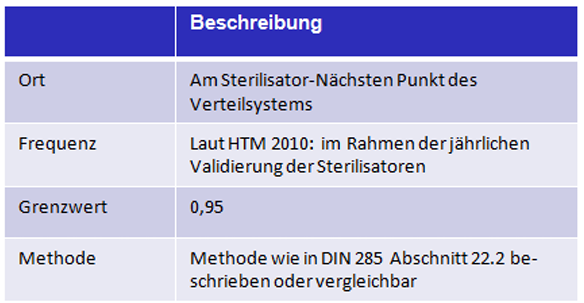
Steam with a high proportion of condensate (wet steam) reduces the energy transferred during the sterilization process and, incidentally, leads to an undesirable high humidification of the sterile goods. Due to the design of the droplet separators, the steam is dry and saturated immediately after the generator. In the event of malfunctions of these separators, insufficient separation can lead to condensate entrainment. This not only results in wet steam conditions but also carries the risk of endotoxin carryover. Further wet steam formation occurs due to condensation in the distribution system. Therefore, the dimensioning, insulation, and drainage of the distribution system have a significant influence on dryness. The measurement should be carried out close to the consumer. As an acceptance criterion, DIN EN 285 [1] specifies a dryness value of 0.95 for metal loads and 0.9 for other loads.
Superheat
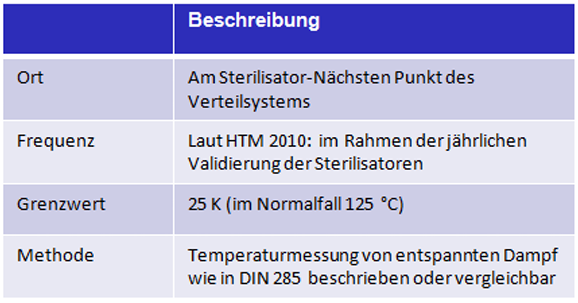
Superheated steam cannot condense during the sterilization process; instead, it must first cool down to the boiling point. Before this, no condensation enthalpy can be transferred to the sterile goods, and the superheated steam behaves like hot air. For successful sterilization, either a longer dwell time or higher temperatures would be necessary. Superheated steam can arise due to a large pressure drop in the distribution system or in the sterilizer. With a pressure reduction, the total enthalpy remains the same. This energy conservation first leads to complete evaporation of any possible condensate and, after saturated steam conditions are reached, to an increase in temperature. The superheat of steam flowing freely into the atmosphere must not exceed 25 K.
Distribution Network
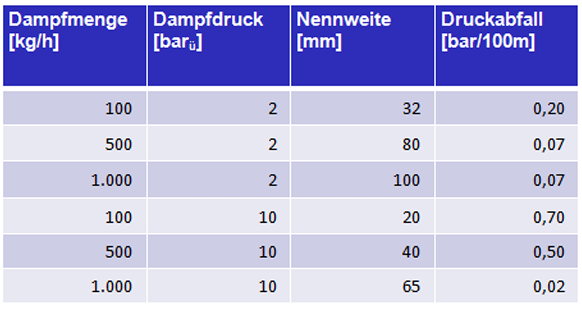
In the pure steam distribution network, due to the compressible medium pure steam, an expansion flow occurs. The pressure decreases due to friction losses along the pipeline. An overview of pressure losses in an ideal system is shown in the adjacent table. Steam velocities are between 25-40 m/s.
The pipeline expands during commissioning due to heating. This effect must be considered during planning, as otherwise, stresses can occur in the distribution network. The supports of a pure steam distribution network must allow axial displacement on straight sections. In longer pipe sections, expansion compensators must also be installed. These must be designed so that no low points form. Fixed points must be mounted so that pipe movement cannot cause damage. To minimize energy losses, condensate formation, and danger to personnel, the distribution network must be insulated. Insulation is aluminum-clad in the technical area and a pipe-in-pipe system in the cleanroom area.
Condensate
Since steam lines are not adiabatic systems, some of the steam will always condense and must be removed from the distribution network. Especially during startup, a large amount of steam will condense in the still unheated distribution network. The distribution network must be designed so that the condensate can drain completely. Separation is carried out via steam traps, of which different designs are available on the market. Condensate separators must be installed at all low points of the distribution network. The slope of the pipeline to the low points should not be less than 1%. The condensate network connected to the pure steam system should be designed to be pressureless.
Venting
When the pure steam system is shut down, air is primarily present throughout the distribution network. During startup, this air is compressed due to the pressure increase. The proportion of non-condensable gases must not exceed a maximum of 3.5%, as described in DIN EN 285 [1]. The air in the system can be discharged via a vent. Mixing of steam and air can be prevented by timely venting after startup.
References
1
DIN EN 285: Sterilization – Steam Sterilizers – Large Sterilizers, German version EN 285:2006 + A2:2009, August 2009
2
DIN Series 58950: Sterilization – Steam Sterilizers for Pharmaceutical Sterile Goods, 2011
3
DIN EN ISO 17665-1: Sterilization of Health Care Products – Moist Heat – Part 1: Requirements for the Development, Validation and Routine Control of a Sterilization Process for Medical Devices, German version EN ISO 17665-1:2006, November 2006
4
ISO 13824: Bases for design of structures – General principles on risk assessment of systems involving structures, 42 pages, November 2009
5
EU Guidelines to Good Manufacturing Practice, Volume 4, Annex 1: Manufacture of Sterile Medicinal Products, European Commission, 25 November 2008 (rev.), Brussels
6
ISPE Baseline R Guide, Volume 4: Water and Steam Systems (Second Edition), Department of Health and Human Services, 01 November 2011, Florida
7
The United States Pharmacopeia, 35th Edition and The National Formulary, 30th Edition, Rockville 2011
8
WHO Technical Report Series, No. 929, Annex 3: Good Manufacturing Practices: water for pharmaceutical use, World Health Organization, 2005