

Handling Microbiological Excursions in Environmental Monitoring
Introduction
Microbiological monitoring ensures that pharmaceutical preparations are manufactured under controlled conditions. It identifies deviations from the validated baseline. If deviations occur (Out-of-Specification results, OOS, or Out-of-Trend results, OOT), corrective actions can be initiated. Microbiological monitoring includes the monitoring of air, process water, surfaces, and personnel.
Environmental Monitoring Program
A comprehensive monitoring concept should be developed for cleanroom monitoring. The monitoring program must be documented in SOPs. These should include the following information regarding sampling: sampling points, frequency, timing, responsibilities, documentation, equipment, and techniques. Furthermore, alert and action limits must be defined. The SOP should also specify the formal and chronological procedure to be followed if an alert or action limit is exceeded.
Alert and Action Limits
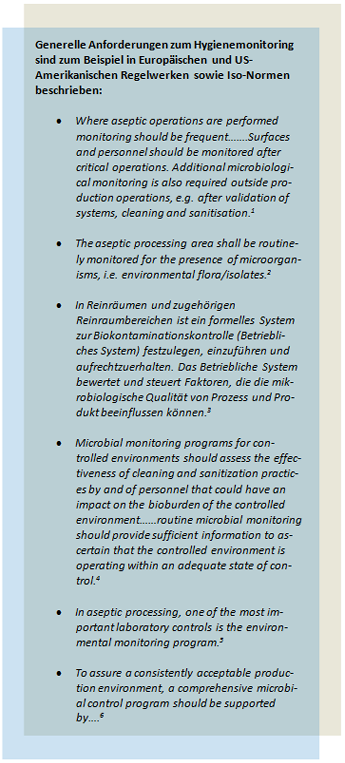
To assess quality, the requirements for the cleanrooms must be described. These requirements are defined as alert and action limits. For action limits, the limits described in the regulations (e.g., USP, Annex 1 (Sterile Manufacturing) EU-GMP Guide, FDA, Guidance for Industry) can be used.
If the action limit itself must be determined, one of the following rules can be applied:
- is, for example, outside the statistically probable range
- or (e.g., for very small measured variables/rare individual findings)
- exceeds the baseline level by 50% or 100% [8]
For alert limits, on the other hand, historical data or results from the qualification phase should be used. The alert limit corresponds to the point where the range in which the measurement data most frequently lay according to data statistics is exceeded. A calculation can then be performed, for example, based on the proposal in DIN/EN 1632 (draft, not implemented). If the alert limit cannot be determined statistically, 1/2 of the action limit is often provisionally set as the alert limit. Exceeding the alert limit does not necessarily trigger a full investigation. It merely identifies a potential drift from normal conditions. In contrast, action limit excursions must always be investigated for their cause and documented.
Handling Deviations
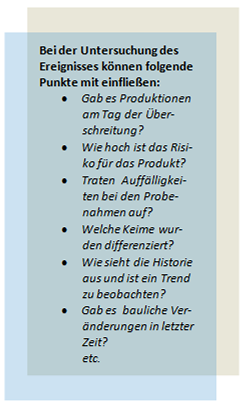
If deviations occur, the production environment is no longer under control. The excursion from the required environmental conditions must be investigated promptly and completed within 30 days. The goal is to find the cause in order to initiate appropriate corrective actions. Furthermore, preventive actions should be initiated so that these deviations do not occur again. This is also referred to as a CAPA plan.
Data Review
The existing data from the monitoring program should be summarized and evaluated regularly. The time intervals can be determined individually and depend on the number of samples and the criticality (role in the process and monitoring results above the alert limit) of the cleanrooms examined. The data review can also be used for a re-evaluation of the alert limit.
Trend Identification
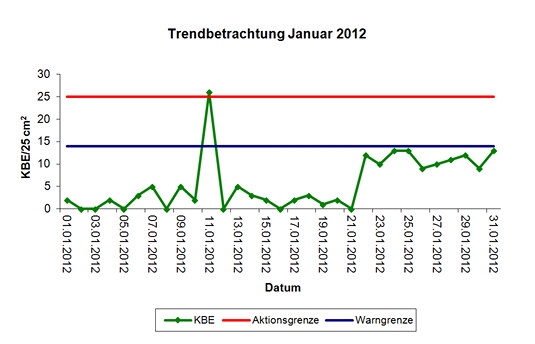
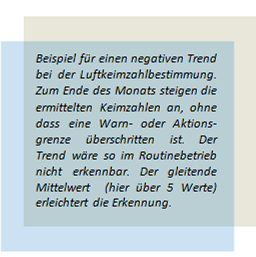
Trend analyses should be performed as part of hygiene monitoring. This requirement has now also been incorporated into the WHO requirements [9]. In this way, emerging deviations from the validated state, e.g., in the case of frequent occurrences of alert limits, can be recognized early and corrective measures can be initiated (OOT—Out of Trend—events). Official guidance can also be found in the relevant literature:
“When data are compiled and analyzed, any trends should be evaluated by trained personnel. While it is important to review environmental results based on recommended and specified frequency, it is also critical to review results over extended periods to determine whether trends are present. Trends can be visualized through the construction of statistical control charts that include alert and action levels. The microbial control of controlled environments can be assessed, in part, based on these trend data.” [4]
“Levels of detection of microbial contamination should be established for the purpose of setting alert and action limits and for monitoring the trends in environmental cleanliness in the facility. “[9]
“The quality control unit should provide routine oversight of near-term (e.g., daily, weekly, monthly, quarterly) and long-term trends in environmental and personnel monitoring data. [5]
“Data determined based on a single sample are often not significant. Furthermore, microbiological monitoring techniques can have serious deficiencies that cause wide variation. A graphical representation of the collected data over a certain period can therefore be useful for distinguishing variations in sampling from actual trends or indicating that a significant change has occurred, even if the estimated values are within the defined limits.” [7]
To facilitate the identification of trends, it is often useful to present the data as moving averages, e.g., from 5–10 consecutive individual values.
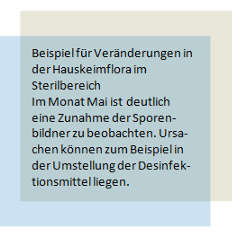
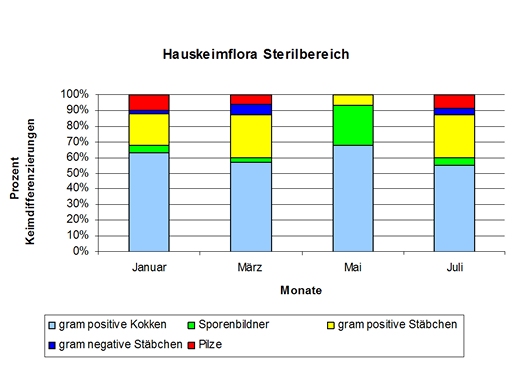
In addition, trending should also be performed with regard to the isolated microbial species. For example, in the case of a frequent occurrence of spore-formers or molds, corrective measures can be initiated in a timely manner.
References
1
EU Guidelines to Good Manufacturing Practice, Volume 4, Annex 1: Manufacture of Sterile Medicinal Products, European Commission, November 2008, Brussels
2
ISO 13408-1:2008-06: Aseptic processing of health care products—Part 1: General requirements, 36 pages
3
ISO 14698-1:2004-04: Cleanrooms and associated controlled environments—Biocontamination control—Part 1: General principles, 38 pages
4
USP 29 <1116>: Microbiological evaluation of clean rooms and other controlled environments
5
FDA: Guidance for Industry—Sterile Drug Products Produced by Aseptic Processing—Current Good Manufacturing Practice, 2004
6
Parenteral Drug Association (PDA): Technical Report No. 13
7
Wallhäuser’s Practice of Sterilization, Thieme Verlag, 2008
8
WHO Technical Report Series, No. 961, Annex 6: WHO good manufacturing practices for sterile pharmaceutical products, World Health Organization, 2011